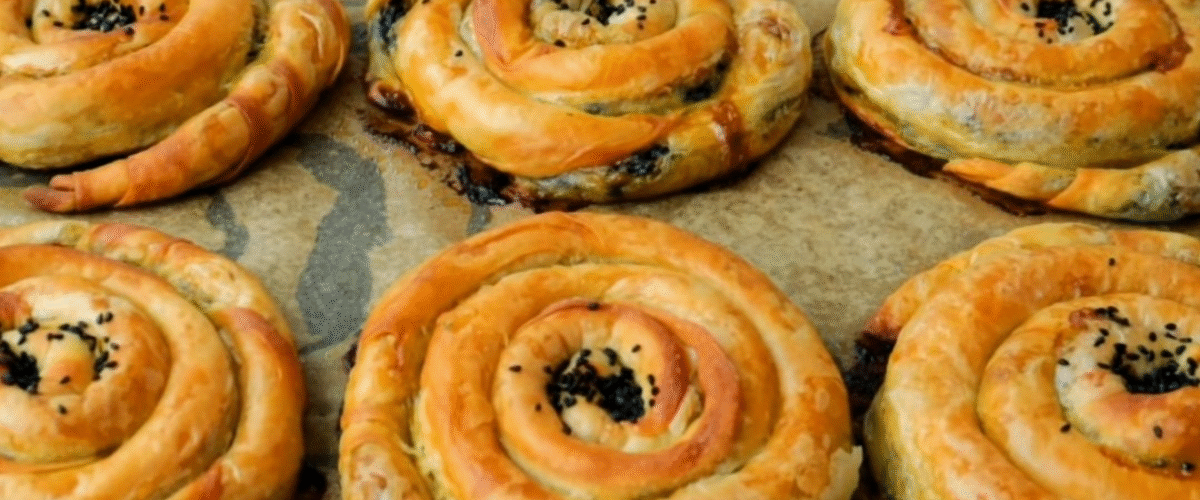
Ce börek turc traditionnel aux épinards représente le summum de la cuisine ottomane, alliant une pâte feuilletée maison fine à une garniture aux épinards richement assaisonnée. Ce travail d’amour crée des couches dorées et feuilletées qui enrobent des épinards et des oignons parfaitement épicés, créant un plat à la fois élégant pour les grandes occasions et réconfortant pour les repas de tous les jours. L’art de préparer un börek maison vous plonge dans des siècles de tradition culinaire turque tout en vous offrant un repas incroyablement nourrissant et satisfaisant.
Ingrédients
Pour la pâte feuilletée :
- 15 cuillères à café (75 g) de sel
- 2 tasses (480 ml) d’eau chaude
- 7 tasses (875 g) de farine à pâtisserie ou de farine tout usage
- 150 g (⅔ tasse) de beurre fondu
- ½ verre à thé turc (60 ml/¼ tasse) d’huile végétale
Pour la garniture aux épinards :
- 5 à 6 cuillères à soupe (75 à 90 ml) d’huile d’olive
- 2 petits oignons finement hachés (environ 300 g)
- 650 g d’épinards frais, soigneusement lavés et hachés
- 15 cuillères à café (75 g) de flocons de piment rouge (pul biber)
- 1 cuillère à café de sel
- ½ cuillère à café de poivre noir fraîchement moulu
Pour l’assemblage et la finition :
- Huile végétale supplémentaire pour le brossage
- 2 cuillères à soupe de graines de cumin noir (graines de nigelle)
- Beurre fondu supplémentaire pour le brossage final
Accompagnements traditionnels :
- Yaourt turc ou sauce tzatziki
- Ayran (boisson au yaourt turc)
- Olives mélangées
- fromage blanc turc ou feta
- Tomates fraîches, coupées en tranches
- Concombres frais, tranchés
Instructions étape par étape
Préparation de la pâte feuilletée
Étape 1 : Dans un grand saladier, dissoudre complètement les 15 cuillères à café de sel dans l’eau chaude. Remuer jusqu’à ce que le sel soit complètement dissous et que l’eau soit claire. Laisser refroidir légèrement jusqu’à ce qu’il soit tiède, mais pas brûlant.
Étape 2 : Commencez par ajouter progressivement la farine à pâtisserie à l’eau salée, en remuant constamment avec une cuillère en bois. Ajoutez environ 500 ml de farine au début, en mélangeant jusqu’à obtenir une pâte hérissée.
Étape 3 : Ajoutez progressivement la farine tout en mélangeant jusqu’à ce que la cuillère ne puisse plus la remuer. Versez le mélange sur un plan de travail propre et commencez à pétrir à la main, en ajoutant le reste de farine au besoin.
Étape 4 : Pétrissez la pâte vigoureusement pendant 8 à 10 minutes jusqu’à ce qu’elle soit lisse, élastique et légèrement collante au toucher. La pâte doit être souple et malléable, ni collante ni sèche. Ajustez la consistance avec un peu d’eau ou de farine si nécessaire.
Étape 5 : Formez une boule lisse avec la pâte, placez-la dans un bol légèrement huilé et couvrez-la d’un torchon humide. Laissez reposer 10 minutes pour permettre au gluten de se détendre.
Division et repos de la pâte
Étape 6 : Après le premier repos, déposez la pâte sur un plan de travail légèrement fariné et divisez-la en 18 parts égales à l’aide d’un couteau bien aiguisé ou d’une corne à pâtisserie. Chaque part doit peser environ 50 à 60 g.
Step 7: Roll each portion into a smooth ball by cupping it in your palm and rolling it against the work surface. Place all the dough balls on a floured tray or baking sheet.
Step 8: Cover the dough balls with a slightly damp kitchen towel and let them rest for another 10 minutes. This second rest is crucial for achieving paper-thin layers.
Creating the Butter-Oil Mixture and Layering
Step 9: In a small bowl, combine the melted butter with the ½ Turkish tea glass of oil. Mix well to create a smooth butter-oil mixture that will be used for brushing between layers.
Step 10: Working with one dough ball at a time, roll each ball out on a lightly floured surface into a thin circle approximately 20cm (8 inches) in diameter. The dough should be thin but not transparent.
Step 11: Brush each rolled circle generously with the butter-oil mixture, ensuring complete coverage from edge to edge.
Step 12: Stack the brushed circles in groups of three, creating 6 stacks total. Each stack should have 3 layers with butter-oil mixture between each layer and on top.
Step 13: Cover the stacks with plastic wrap or a damp towel and let them rest for 30-35 minutes. This extended rest allows the dough to relax further and makes final rolling easier.
Preparing the Spinach Filling
Step 14: While the dough stacks are resting, heat the olive oil in a large skillet or wide pan over medium heat. Add the finely chopped onions and sauté for 5-7 minutes until they become translucent and lightly golden.
Step 15: Add the chopped spinach to the pan in batches if necessary, as fresh spinach takes up considerable space initially. Cook, stirring frequently, until the spinach wilts completely and releases its moisture.
Step 16: Continue cooking the spinach mixture for 8-10 minutes, stirring occasionally, until most of the liquid has evaporated. The mixture should be relatively dry to prevent soggy borek.
Step 17: Season the spinach mixture with the red pepper flakes, salt, and black pepper. Stir well to distribute the seasonings evenly throughout the mixture.
Step 18: Remove the spinach filling from heat and set aside to cool completely. The filling must be at room temperature before assembly to prevent the dough from becoming soggy.
Final Assembly and Shaping
Step 19: Preheat your oven to 190°C (375°F). Line a large baking sheet with parchment paper or lightly grease it with oil.
Step 20: Working with one stack at a time, roll out each 3-layer stack on a lightly floured surface until it’s approximately 40cm (16 inches) in diameter and paper-thin. You should be able to see your hand through the dough when held up to the light.
Step 21: Spread approximately 2-3 tablespoons of the cooled spinach filling along one edge of the rolled-out dough, leaving a 2cm border on the sides and bottom.
Step 22: Carefully roll the dough around the filling, creating a tight log. Tuck in the sides as you roll to prevent the filling from escaping during baking.
Step 23: Place the filled borek seam-side down on the prepared baking sheet. Repeat this process with all remaining dough stacks and filling.
Final Preparation and Baking
Step 24: Brush the tops and sides of all borek rolls generously with additional oil to ensure a golden, crispy exterior during baking.
Step 25: Sprinkle the black cumin seeds evenly over the tops of the borek rolls, pressing them gently into the surface so they adhere during baking.
Step 26: Using a sharp knife, make 3-4 shallow diagonal cuts across the top of each borek roll. This allows steam to escape and prevents the pastry from splitting during baking.
Step 27: Bake for 45-50 minutes, rotating the baking sheet once halfway through, until the borek are deep golden brown and crispy on all sides.
Step 28: Remove from the oven and let cool for 5-10 minutes before serving. This brief cooling period allows the layers to set and makes slicing easier.
Nutritional Information
Prep Time: 2 hours (including resting time)
Cooking Time: 50 minutes
Total Time: 2 hours 50 minutes
Servings: 12-15 portions
Per Serving (approximate):
- Calories: 285
- Carbohydrates: 42g
- Protein: 8g
- Fat: 10g
- Fiber: 4g
- Sugar: 3g
- Sodium: 465mg
- Iron: 3.2mg (from spinach)
Variations and Substitutions
Cheese Spinach Borek: Add 200g of crumbled feta cheese or Turkish white cheese to the spinach filling for extra richness and protein. Reduce the salt in the filling accordingly.
Meat Borek: Replace the spinach filling with a mixture of 500g ground lamb or beef, sautéed onions, and traditional Turkish spices including cinnamon, allspice, and pine nuts.
Whole Wheat Version: Substitute up to half of the pastry flour with whole wheat flour for added nutrition. You may need to add slightly more water to achieve the proper dough consistency.
Vegan Option: Replace the butter in the dough with additional vegetable oil or vegan butter substitute. Ensure all accompaniments are plant-based.
Herb Enhancement: Add 2 tablespoons of fresh dill and 1 tablespoon of fresh mint to the spinach filling for additional Mediterranean flavors.
Make-Ahead Method: Assemble the borek completely, then freeze on baking sheets. Once frozen solid, transfer to freezer bags and store for up to 3 months. Bake directly from frozen, adding 10-15 minutes to the cooking time.
Questions fréquemment posées
Puis-je utiliser de la pâte phyllo du commerce au lieu de la faire moi-même ? Bien que la pâte maison offre une saveur et une texture supérieures, vous pouvez la remplacer par de la pâte phyllo du commerce. Utilisez 12 à 15 feuilles, badigeonnez-les chacune du mélange beurre-huile et disposez-les par groupes de 3 ou 4 feuilles avant de les garnir et de les étaler.
Pourquoi mes börek ne sont-ils pas assez croustillants ? Assurez-vous que la garniture aux épinards soit bien refroidie et relativement sèche avant l’assemblage. Badigeonnez-les généreusement d’huile avant la cuisson et évitez de les recouvrir pendant le refroidissement, car la vapeur emprisonnée ramollirait la croûte.
Comment conserver les restes de borek ? Conservez-les refroidis au réfrigérateur jusqu’à 4 jours dans un récipient hermétique. Pour les rendre croustillants, réchauffez-les au four à 180 °C (350 °F) pendant 8 à 10 minutes plutôt qu’au micro-ondes.
Puis-je préparer la pâte la veille ? Oui, vous pouvez la préparer pendant le premier repos, l’envelopper hermétiquement dans du film plastique et la conserver au réfrigérateur toute la nuit. Laissez-la revenir à température ambiante avant de la diviser et de poursuivre la recette.
Quelle est la meilleure façon de réchauffer un borek ? Pour un résultat optimal, réchauffez les restes de borek dans un four préchauffé à 180 °C (350 °F) pendant 8 à 12 minutes, jusqu’à ce qu’ils soient bien chauds et croustillants. Évitez le micro-ondes, car cela ramollirait la pâte.
Ce börek aux épinards authentique incarne l’essence même de la cuisine turque traditionnelle, où le temps et le soin transforment des ingrédients simples en expériences culinaires extraordinaires. Le contraste entre la croûte croustillante et la garniture savoureuse aux épinards parfumée aux herbes crée un plat à la fois gourmand et raffiné. Accompagné d’accompagnements turcs traditionnels, il vous offrira une expérience culinaire complète, célébrant le riche héritage de la cuisine ottomane, tout en offrant un repas nutritif et savoureux qui réunira les familles autour de la table.