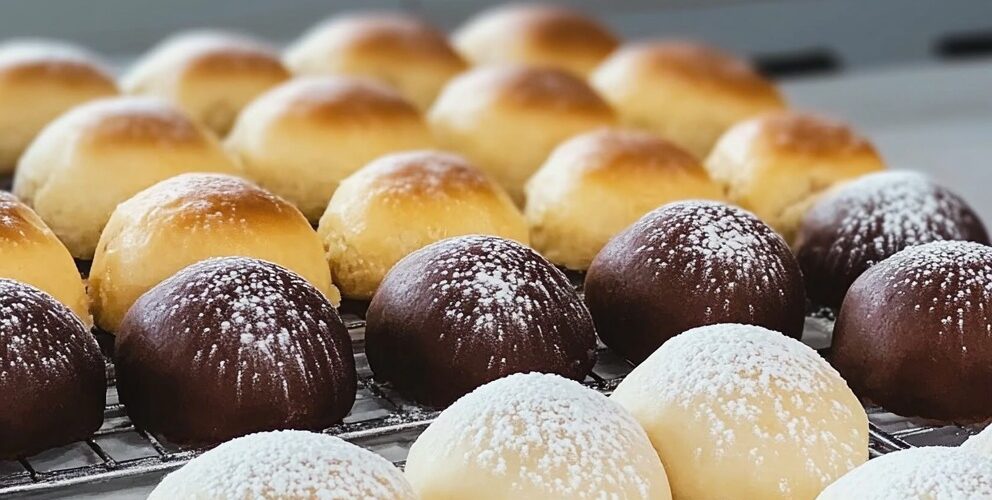
Ces spectaculaires petits pains double pâte allient le meilleur des deux mondes : des petits pains au chocolat riches et gourmands et des petits pains nature classiques à la levure. Cette recette unique crée deux saveurs distinctes à partir d’une même pâte, idéale pour les familles aux goûts variés ou les occasions spéciales où la variété est essentielle. Leur texture moelleuse et moelleuse, ainsi que le magnifique contraste entre les versions chocolat et nature, font de ces petits pains un ajout impressionnant à tout repas ou réception.
Ingrédients
Ingrédients de base :
- 300 ml (1¼ tasse) de lait chaud, divisé en deux portions de 150 ml
- 8 g (2¼ cuillères à café) de levure sèche active
- 2 cuillères à café de levure chimique
- 5 cuillères à soupe (75 g) de sucre cristallisé
- ½ cuillère à café de sel
- 2 gros œufs
- 700 à 750 g (5½ à 6 tasses) de farine de blé (farine tout usage)
- 60 g (4 cuillères à soupe) de beurre ramolli
Pour la pâte au chocolat :
- 2½ cuillères à soupe (20 g) de cacao en poudre non sucré
Pour la dorure à l’œuf :
- 1 gros jaune d’œuf
- 1 cuillère à soupe de lait
Instructions étape par étape
Préparation du mélange de base
Étape 1 : Commencez par chauffer le lait à environ 37 °C (98 °F). Le lait doit être agréablement chaud au toucher, mais pas brûlant, car une chaleur excessive tuerait la levure. Divisez le lait chaud en deux portions égales de 150 ml chacune dans des saladiers séparés.
Étape 2 : Ajoutez 4 g (environ la moitié) de levure sèche à chaque bol de lait chaud. Saupoudrez la levure sur la surface et laissez reposer 5 à 8 minutes jusqu’à ce que le mélange mousse et bouillonne, indiquant que la levure est active et prête à agir.
Étape 3 : Dans chaque bol, ajoutez 1 cuillère à café de levure chimique, 2,5 cuillères à soupe de sucre, ¼ de cuillère à café de sel et 1 œuf. Fouettez vigoureusement chaque mélange jusqu’à ce que tous les ingrédients soient bien mélangés et que le mélange soit lisse et homogène.
Création des deux pâtes
Étape 4 : Pour la pâte au chocolat, ajoutez les 2,5 cuillères à soupe de cacao en poudre dans l’un des bols. Fouettez vigoureusement jusqu’à ce que le cacao soit bien incorporé et qu’il ne reste plus de grumeaux. Le mélange doit avoir une belle couleur chocolat.
Étape 5 : Dans chaque bol, ajoutez 30 g (2 cuillères à soupe) de beurre ramolli. Mélangez bien jusqu’à ce que le beurre soit bien incorporé.
Étape 6 : Commencez à ajouter la farine progressivement dans les deux bols, en commençant par 350 à 375 g (environ 2,75 à 3 tasses) dans chaque bol. Remuez continuellement jusqu’à obtenir une pâte hérissée.
Pétrissage et première levée
Étape 7 : Déposez les deux pâtes sur des plans de travail séparés, légèrement farinés. Pétrissez chaque pâte pendant 8 à 10 minutes jusqu’à ce qu’elles soient lisses, élastiques et légèrement collantes au toucher. La pâte au chocolat peut nécessiter un peu plus de farine en raison des propriétés absorbantes du cacao en poudre.
Step 8: Place each kneaded dough in separate, lightly oiled bowls. Cover both bowls with damp kitchen towels or plastic wrap and place them in a warm, draft-free location.
Step 9: Allow both doughs to rise for 60-90 minutes, or until they have doubled in size. The rising time may vary depending on the temperature and humidity of your kitchen environment.
Shaping and Second Rise
Step 10: Once the doughs have doubled in size, gently punch them down to release the accumulated gases. Turn both doughs out onto lightly floured surfaces.
Step 11: Divide each dough into 8-10 equal portions, giving you a total of 16-20 rolls. Shape each portion into smooth, round balls by rolling them under your cupped palm on the work surface.
Step 12: Arrange the shaped rolls on two parchment-lined baking sheets, alternating between chocolate and plain rolls for an attractive presentation. Leave approximately 2 inches of space between each roll to allow for expansion during the second rise.
Step 13: Cover the shaped rolls with clean kitchen towels and let them rise for an additional 30-45 minutes, until they appear puffy and have increased in size by approximately 50%.
Final Preparation and Baking
Step 14: During the last 15 minutes of the second rise, preheat your oven to 180°C (350°F). Position the oven racks in the upper and lower thirds of the oven.
Step 15: Prepare the egg wash by whisking together the egg yolk and 1 tablespoon of milk until smooth. Using a pastry brush, gently brush the tops of all rolls with the egg wash for a beautiful golden finish.
Step 16: Bake the rolls for 24-27 minutes, rotating the baking sheets halfway through the baking time to ensure even browning. The rolls are done when they are golden brown on top and sound hollow when gently tapped on the bottom.
Step 17: Remove the rolls from the oven and let them cool on the baking sheets for 5 minutes before transferring to wire racks to cool completely.
Nutritional Information
Prep Time: 45 minutes
Rising Time: 2-2.5 hours total
Baking Time: 24-27 minutes
Total Time: 3.5-4 hours
Servings: 16-20 rolls
Per Roll (approximate):
- Calories: 195
- Carbohydrates: 36g
- Protein: 6g
- Fat: 4g
- Fiber: 2g (3g for chocolate rolls)
- Sugar: 5g
- Sodium: 145mg
Variations and Substitutions
Whole Wheat Option: Replace up to half of the all-purpose flour with whole wheat flour for added nutrition and a nuttier flavor. You may need to add slightly more liquid to compensate for the wheat flour’s higher absorption rate.
Dairy-Free Alternative: Substitute the milk with unsweetened plant-based milk such as almond, oat, or soy milk. Replace the butter with vegan butter or coconut oil for a completely dairy-free version.
Enhanced Chocolate Flavor: Add 60g of mini chocolate chips to the chocolate dough during the final stages of kneading for extra chocolate bursts throughout the rolls.
Sweet Glaze Options: Create a simple vanilla glaze by mixing 150g powdered sugar with 3 tablespoons of milk and 1 teaspoon of vanilla extract. For chocolate rolls, add 1 tablespoon of cocoa powder to the glaze mixture.
Herb and Garlic Variation: Transform the plain dough into savory rolls by adding 2 teaspoons of dried herbs (such as rosemary or thyme) and 2 minced garlic cloves to the plain dough mixture.
Overnight Option: After shaping the rolls, cover and refrigerate overnight. Allow them to come to room temperature and complete their second rise before baking.
Frequently Asked Questions
Can I make just one type of dough instead of both? Absolutely! Simply use all 300ml of milk in one bowl and double the other ingredients accordingly. For all-chocolate rolls, use 5 tablespoons of cocoa powder total. This will yield approximately 16-20 rolls of one variety.
Why do I need both yeast and baking powder in this recipe? The combination of yeast and baking powder creates exceptionally light and fluffy rolls. The yeast provides the primary leavening and develops flavor during the rising process, while the baking powder gives an extra lift during baking, resulting in a superior texture.
How can I tell if my dough has risen enough? The dough should approximately double in size and feel light and airy when gently poked. You can perform the “poke test” by gently pressing your finger about half an inch into the dough. If the indentation remains and doesn’t spring back immediately, the dough is ready.
What’s the best way to store these rolls? Store cooled rolls in an airtight container at room temperature for up to 3 days. For longer storage, wrap individual rolls in plastic wrap and freeze for up to 3 months. To refresh day-old rolls, warm them in a 150°C (300°F) oven for 5-7 minutes.
Can I prepare the dough in advance? Yes, you can prepare the dough through the first rise, then punch it down, wrap tightly in plastic wrap, and refrigerate for up to 24 hours. Allow the dough to come to room temperature before shaping and proceeding with the second rise.
Ces petits pains double pâte sont la solution idéale pour les familles aux goûts variés. Le contraste subtil entre le chocolat riche et le pain nature classique en fait un choix idéal pour les grandes occasions, les fêtes de fin d’année ou pour créer une expérience culinaire unique. Leur mie moelleuse et tendre et leur croûte dorée rendent ces petits pains irrésistibles dès la sortie du four, et ils sont tout aussi délicieux le lendemain, une fois réchauffés.